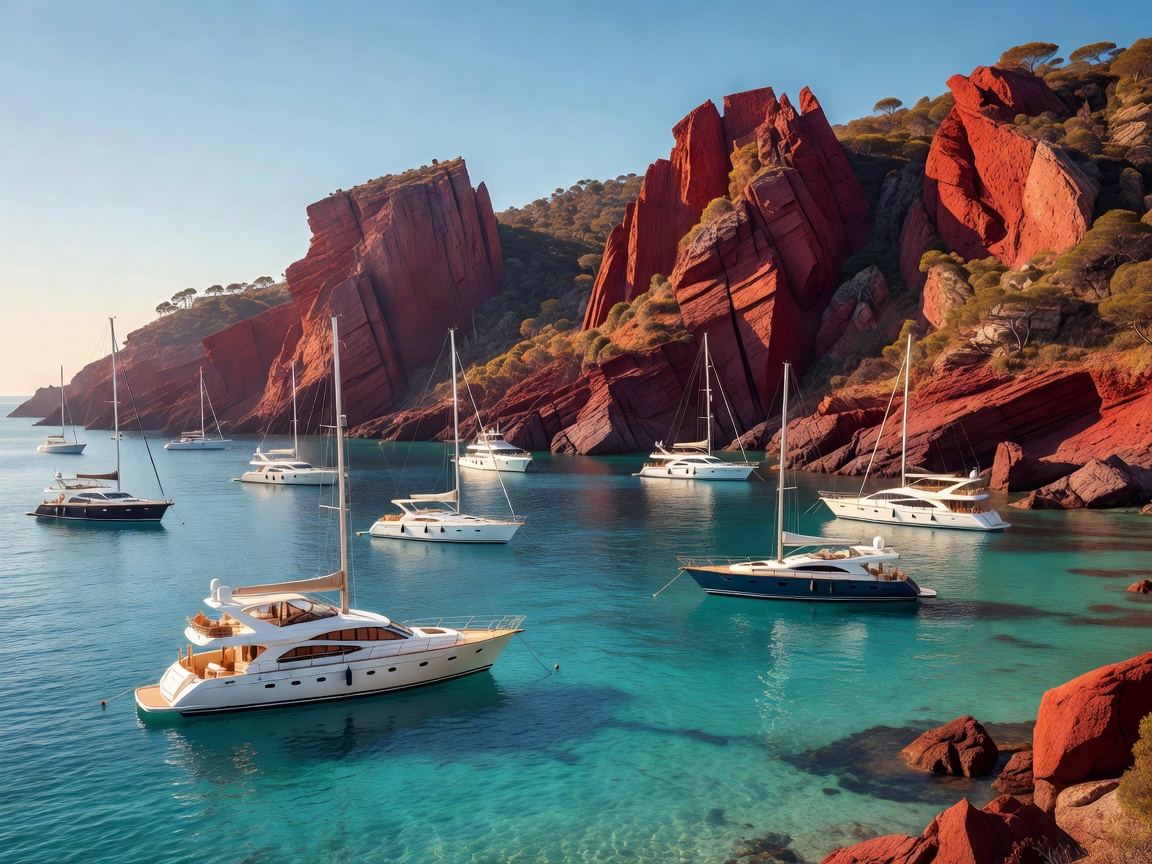
Saint-Raphaël sits at a useful crossroads. To the east rise the porphyry cliffs of the Esterel massif and the coves around Agay; to the west lie Fréjus, Sainte-Maxime and the Gulf of Saint-Tropez. The town has a large modern marina, Port Santa Lucia, alongside its older harbour, and a sailing public that ranges from retirees on family cruisers to weekend day-sailers from inland Provence.
Why budget buyers look here
Compared with Cannes or Antibes further east, Saint-Raphaël generally shows a broader mix of ordinary family boats and fewer large yachts crowding the listings. That tends to widen the choice at the accessible end. The area's boatyards and dry-storage facilities also mean boats are often sold ashore, where you can inspect the hull without arranging a lift.
What you will typically find
| Boat type | Typical profile | Watch for |
|---|---|---|
| Pocket cruiser (6–8 m) | Older French production boats, outboard or small inboard | Soft decks, tired outboards, sails past their best |
| Family cruiser (9–11 m) | Two- or three-cabin boats from mainstream French yards | Engine hours, rigging age, amateur electrical upgrades |
| Former charter yacht | Well equipped, heavily used, serviced on a schedule | Interior wear, winches, sails; ask for maintenance logs |
| Day-sailer | Open or semi-open boats for bay sailing | Trailer condition, centreboard or lifting-keel gear |
Former charter boats deserve a special note. The Côte d'Azur supports charter fleets, and boats rotate out of service after a period of use. They can be good value: systems are usually maintained on a schedule and equipment lists are long. The trade-off is intensive use by many different crews, so interiors, winches and sails often show it.
Sailing conditions and wear
The Var coast is less exposed to the Mistral than Marseille, but it still reaches here, and easterly winds can push short, steep seas into the gulf. Summer brings intense sun and heat, so UV damage to canvas, sprayhoods and cockpit cushions is common. In winter, boats left unattended may suffer from poor ventilation below — check for mould, damp headlinings and corroded electrical connections behind panels.
Berths, dry storage and running costs
As along most of the French Mediterranean, finding an annual berth can be the hardest part of ownership. Port Santa Lucia is large, but demand is high. Many local owners choose dry storage — a dry stack or hard standing at a boatyard — and launch when needed. For smaller boats this can be more economical, and it reduces antifouling and hull maintenance.
Ask sellers what the boat currently costs to keep: berth or storage fees, insurance, annual servicing and the annual navigation tax (droit annuel de francisation et de navigation) where it applies. These recurring costs will shape your real budget more than the purchase price.
Pros and cons
Pros
- Wide choice of mainstream family boats.
- Many boats sold ashore, which eases inspection.
- Excellent cruising: Esterel coves, Lérins islands, Gulf of Saint-Tropez.
- Good boatyard and dry-storage infrastructure.
Cons
- Summer demand puts pressure on visitor berths.
- Ex-charter boats carry heavy wear.
- Easterly swell can make some anchorages uncomfortable.
- Riviera proximity can inflate some asking prices.
Cruising reach from Saint-Raphaël
A modest cruiser can explore a lot from here. Within a day's sail lie the Îles de Lérins off Cannes, the anchorages around Cap Dramont and the Gulf of Saint-Tropez. With more time, the Îles d'Hyères — Porquerolles, Port-Cros and Le Levant — make a classic coastal passage. Check local rules before anchoring: the French Mediterranean has protected posidonia seagrass meadows, and anchoring restrictions apply in many areas.
Questions to ask the seller
- Has the boat been in charter, and for how long?
- When was it last out of the water, and what work was done?
- Where is it kept now, and can that arrangement continue after the sale?
- Are the registration papers and any VAT evidence in order?